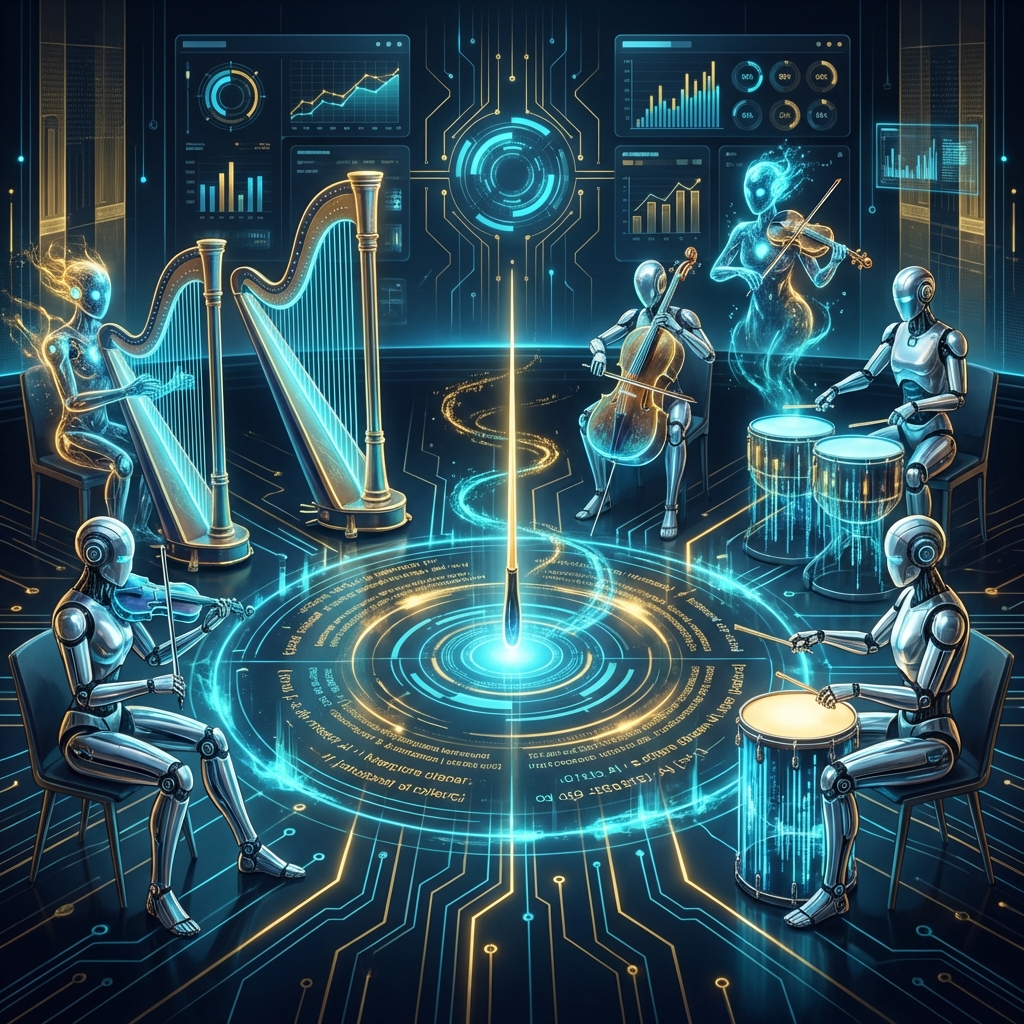
Building a single AI tool is fun. It's like playing a flute in the park. But a fleet of autonomous agents working together? That's not a solo act anymore. It's a complex, messy digital orchestra. At Berlin AI Labs, we stopped trying to just "write good code" and started treating our system like a performance. Every line of logic is a note in a Master Score.
The Score and the Sound
In traditional engineering, you focus on the pipes and the wiring. But with agents, you need something deeper. You need a hierarchy of truth. Imagine an orchestra where the violinist decides to rewrite the melody halfway through the second movement because they "felt like it." That's what LLMs do if you let them. Chaos.
We fix this by separating intent from the action. We call our specifications the Master Score. This is the absolute truth. If the sound coming from the instruments (the agents) doesn't match the ink on the page (the spec), the sound is wrong. We never change the music to fit a mistake. We correct the performance.
The Rhythm of Execution
Managing thirty different projects requires a metronome, not just good intentions. We use an atomic loop that functions like a conductor's baton. Every movement is calculated. Every transition is verified.
Before an agent even touches a keyboard, it reads the room. Specifically, it reads the current state of the performance, identifies the next unplayed passage, plays its part, and then stops. It waits for the downbeat.
The Live Dashboard of Intelligence
To visualize this symphony, we built the Studio Command Center. It is our mission control. It allows us to see every project category from infrastructure to creative tools in one place. We can track technical debt as if it were a slight tuning issue in the brass section.
By connecting our local environment directly to this dashboard, we have created a live reflection of our engineering state. It is no longer a static map. It is a breathing ecosystem. We can see exactly where our self healing loops are active and which agents are currently holding the baton.
Conclusion: Composing the Future
The future of AI is not in larger models but in better synchronization. When we treat our development environment as a single engineered system rather than a collection of folders, the possibilities expand. We are no longer just writing code. We are composing autonomous intelligence.
If you want to move away from the noise of unmanaged agents and towards the clarity of a synchronized digital orchestra, the path is clear. It starts with the score. It continues with the rhythm. And it ends with a performance that stays perfectly in tune.